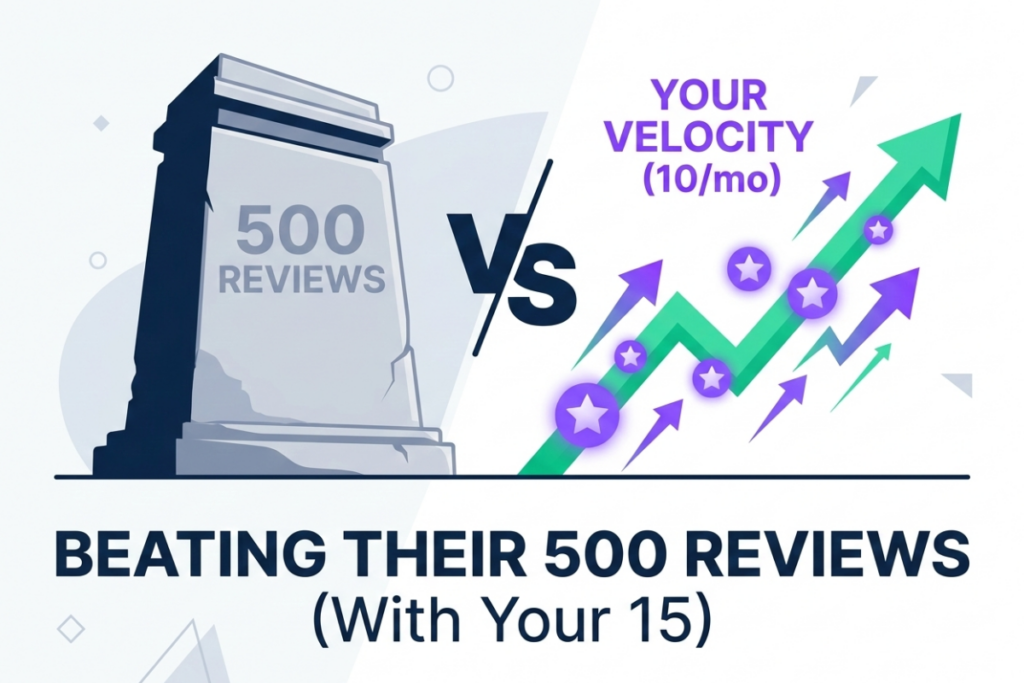
You check your competitor’s Google profile. 523 reviews. 4.7 stars.
You check yours. 15 reviews. 4.9 stars.
Your first thought: “I can never catch up.”
Your second thought: “Why bother trying?”
Here’s the truth: You’re right that you can’t catch up to 523 reviews quickly. But you’re wrong that it matters. Let me explain why you can still outrank them and exactly how to do it.
The Old Game vs. The New Game
- The old game (pre-2025): Total review count was king. Whoever had the most reviews won. Simple.
- The new game (2026): Recent review velocity + quality + engagement matter far more than total count.
Google’s algorithm changed because they realized something: A business with 500 reviews from 2018-2022 and only 2 new reviews per month is less relevant than a business with 50 reviews getting 10 per month consistently. The algorithm favors momentum over historical volume.
What This Means for You
You don’t need 500 reviews to outrank someone with 500 reviews. You need:
- Velocity: More reviews per month than your competitors.
- Quality: Detailed reviews with keywords and specific locations.
- Response Rate: Responding to 100% of reviews within 24-48 hours.
- Consistency: Sustained momentum over 6-12 months.
The Math That Works in Your Favor
Let’s say your competitor has 500 reviews built over 5 years. That’s an average of 8 per month, but in reality, most came early on. Now, they’re only getting 2-3 per month. You currently have 15 reviews. Starting this month, you implement a system to get 8-10 reviews per month.
Here is how the math plays out:
| Timeframe | Your Reviews (10/mo) | Competitor Reviews (2/mo) |
| Month 1 | 25 | 502 |
| Month 3 | 45 | 506 |
| Month 6 | 75 | 512 |
| Month 12 | 135 | 524 |
At month 6, you’re still behind in total count, but Google sees your high velocity, your 100% response rate, and your detailed review quality. Google ranks you #3. They drop to #5. You win with 135 reviews vs. their 524.
How to Actually Get 8-10 Reviews Per Month
Step 1: Ask at the Right Moment
Don’t email them 2 weeks later. Ask immediately after you deliver value and they are most satisfied. This is the “moment of relief.” Asking doesn’t feel pushy. It feels natural.
Step 2: Make It Dead Simple
Before you leave, set the expectation:
“Great news—everything’s fixed! Quick favor? If you’re happy with our service, would you mind leaving us a Google review? It helps other [City] families find a service they can trust. I can text you the link right now.”
Then immediately text them:
“Hi [Name], it’s [Your Name] from [Business]. So glad we could help today! If you have 2 minutes, a Google review helps us serve more [City] families: [LINK]. Thanks!”
Step 3: Follow Up Once (and Only Once)
48 hours later, if they haven’t reviewed, send ONE more text:
“Hi [Name], hope everything’s still working great! If you get a chance, that Google review would really help us: [LINK]. Thanks again!”
Step 4: Respond to Every Single Review
Response rate is a direct engagement signal to Google. Use these templates:
- 5-star reviews: “Thank you for trusting [Business] with your [Service] in [City]! We’re so glad we could help. Call us anytime at [PHONE].”
- 4-star reviews: “Thank you, [Name]. If there’s anything we can do to earn that 5th star next time, please call us at [PHONE].”
- 3-star or lower: “[Name], we’re sorry we didn’t meet your expectations. Please call me directly at [PHONE] so we can make this right. – [Your Name], Owner”
What Makes a High-Quality Review?
Not all 5-star reviews are equal.
- Low-value review: “Great job!” ⭐⭐⭐⭐⭐
- High-value review: “ABC Plumbing saved the day! Fast response for our emergency water heater repair in Tulsa. John was professional, explained everything, and had us back up and running in under 2 hours. Highly recommend for anyone needing a reliable plumber in the Tulsa area!” ⭐⭐⭐⭐⭐
When you text the review link, subtly coach them: “If you mention the specific service we provided and that we’re in [City], it really helps other families find us.”
What If You’re in a REALLY Competitive Market?
If your competitor has 2,000 reviews (like a national chain), you need specialist positioning. If you’re “Tulsa Bed Bug Specialist” with 100 reviews vs. a general pest control company with 2,000 reviews, Google favors you for specific searches because you’re the specialist.
The Bottom Line
Your competitor’s 500 reviews are impressive, but they’re old, generic, and stagnant. Your 15 reviews + systematic generation + 100% response rate will beat them in 6-12 months. Start building momentum today.
Want to see how your current review strategy stacks up? Take our free trust score check. It shows exactly where your reviews are helping or hurting your rankings and gives you the top 3 fixes.